Pioneering Precision with ABEmax Technology
An Advanced Adenine Base Editor for Precise Genome Editing - ABEmax
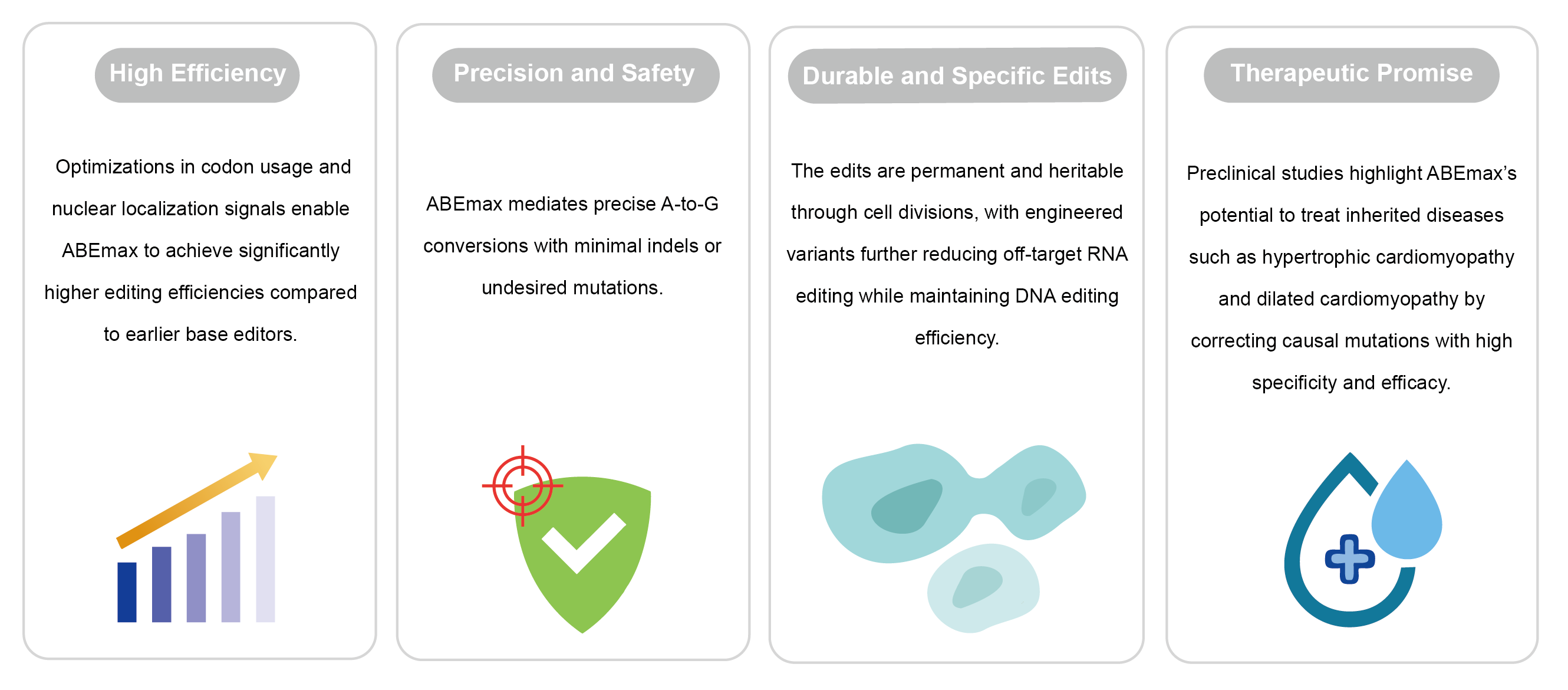
ABEmax represents a significant advancement in the field of genome engineering, enabling highly precise single-nucleotide conversions without inducing DNA double-strand breaks. As an optimized variant of adenine base editors (ABEs), ABEmax mediates efficient and specific A•T to G•C transitions within genomic DNA. This refined molecular tool has become a pivotal platform in genetic research, therapeutic genome editing, and biotechnology innovation.
.png)
The molecular mechanism of ABEmax
ABEmax is a gene editing tool that combines an evolved adenine deaminase enzyme (TadA*) with the CRISPR-Cas9 system to achieve precise A-to-G (adenine to guanine) base conversion in DNA. The core mechanism relies on the engineered TadA* enzyme, which specifically catalyzes the deamination of adenine in single-stranded DNA, converting it into inosine. During DNA replication, inosine is interpreted as guanine by the cellular machinery, thereby effectively changing an A·T base pair into a G·C base pair without introducing double-strand breaks.
.png)
ABEmax consists of three key components that work synergistically to achieve precise base editing:
・Cas9 Nickase (nCas9): A modified version of Cas9 that retains its ability to bind DNA through guide RNA targeting but can only nick one strand of the DNA double helix. This modification prevents the formation of potentially dangerous double-strand breaks while maintaining targeting specificity.
・Evolved TadA Deaminase: ABEmax incorporates both a wild-type E. coli tRNA adenosine deaminase (TadA) and an evolved adenine deaminase variant (TadA*) that has been engineered to deaminate DNA adenosines. The heterodimeric structure of these deaminases is crucial for optimal editing efficiency.
・Guide RNA (gRNA): This component directs the ABEmax complex to specific genomic loci, ensuring precise targeting of the desired adenine residues.
.png)
・Cas9 nickase + sgRNA targeting:
A catalytically impaired Cas9 (D10A nickase) is guided by an sgRNA to a specific DNA region (protospacer next to a PAM). Unlike standard CRISPR, it only nicks one strand rather than cutting both.
▼
・TadA based deamination:
Fused to Cas9 is a heterodimer of wild type E. coli TadA and evolved TadA*. This engineered enzyme binds transiently to the exposed single stranded DNA within the DNA–RNA R loop and deaminates adenine (A) to inosine (I)
▼
・Inosine read through and repair:
Adenine Base Editors (ABEs) are a specialized class of base editors capable of precisely converting adenine (A) bases to inosine (I). During subsequent DNA replication or repair processes, inosine (I) is recognized as guanine (G), ultimately leading to an A•T to G•C base pair substitution.
▼
・Nick directed strand resolution:The nick in the unedited (non-deaminated) strand biases repair toward using the I-containing strand as a template, enhancing A-to-I retention and reducing unwanted insertions/deletions
.png)

.png)

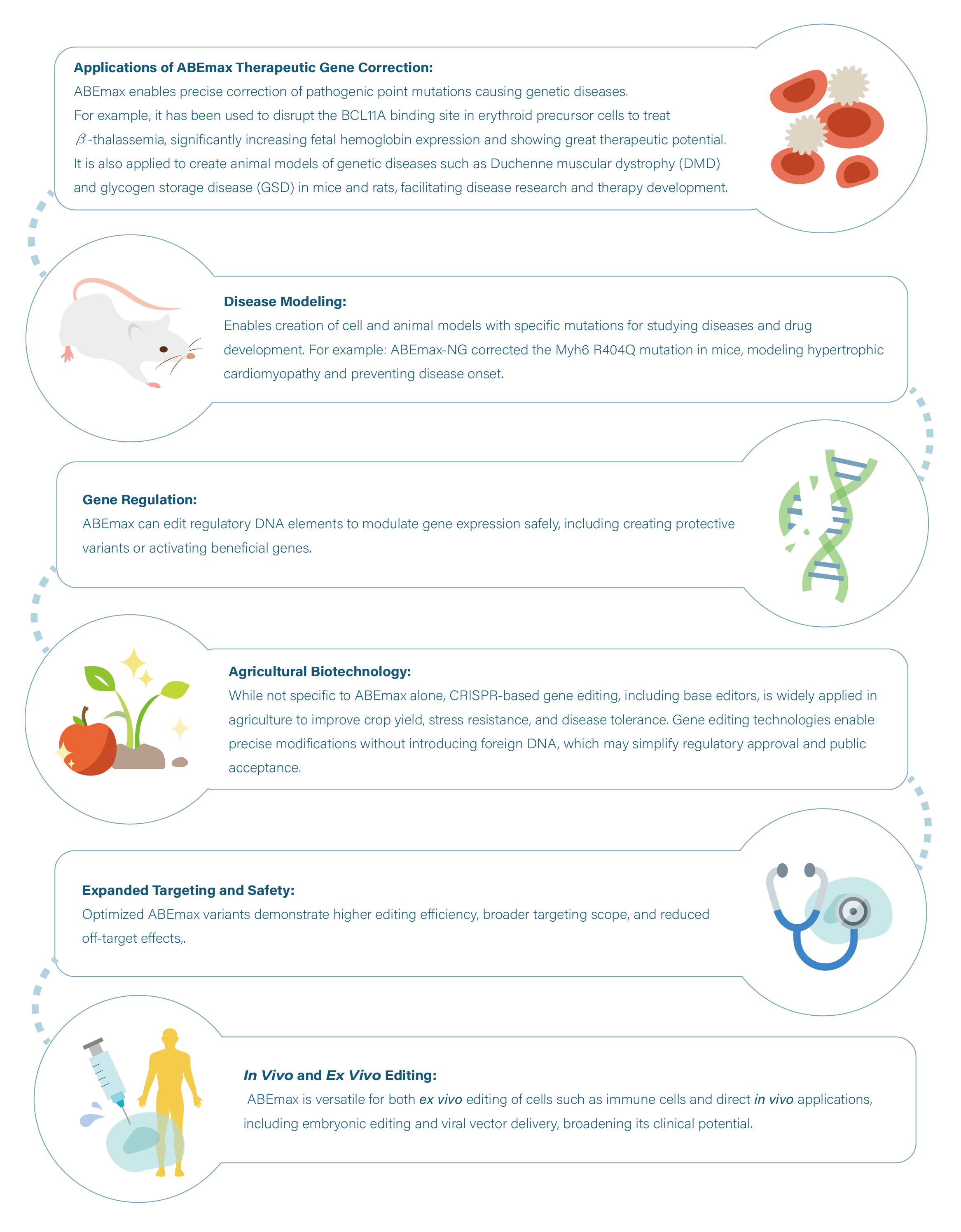
ABEmax represents a robust and precise tool for targeted adenine base editing, expanding the scope of possible therapeutic and research applications by enabling correction of many pathogenic point mutations with high specificity and efficiency.
Other related academic articles:
.png)